
Two Longtime Georgetown Faculty Leaders Move to Emeritus Roles
(June 26, 2026) — Two longtime Georgetown University Medical Center faculty leaders — Phyllis R. Magrab, PhD, and Richard Schlegel, MD, PhD — are moving to emeritus roles after careers that have left an outsized imprint on the institution and the world.
Together, they have contributed nearly 100 years to Georgetown, training generations of researchers and clinicians and producing scholarship with reach far beyond the medical center.
“Georgetown has been fortunate to have Phyllis and Dick as leaders in our community. Each has left an indelible mark on this University,” said John J. DeGioia, president emeritus of Georgetown. “Our world is better because of the research they contributed and the students they taught. I will forever be grateful to each of them for the time we spent together over these many years.”
Different as their fields are, Magrab and Schlegel built programs and mentored trainees and early career faculty in ways designed to outlast them. When asked about the significance of their careers, both deflect toward the work itself and the impact it has had on millions of lives, rather than their own role in it.
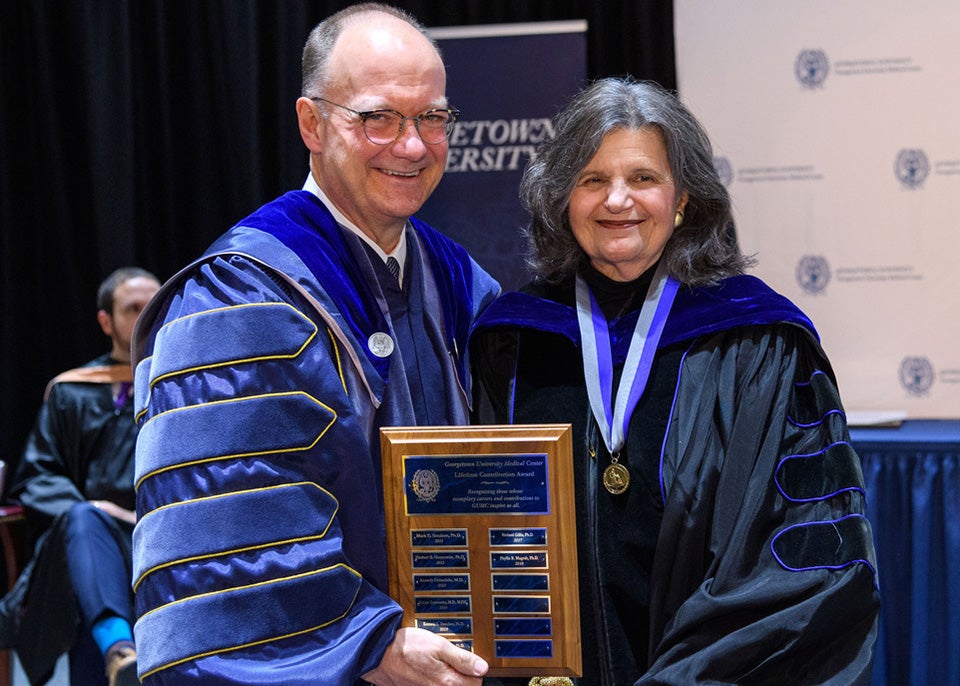
John J. DeGioia presenting Phyllis Magrab with the Lifetime Contribution Award in 2018
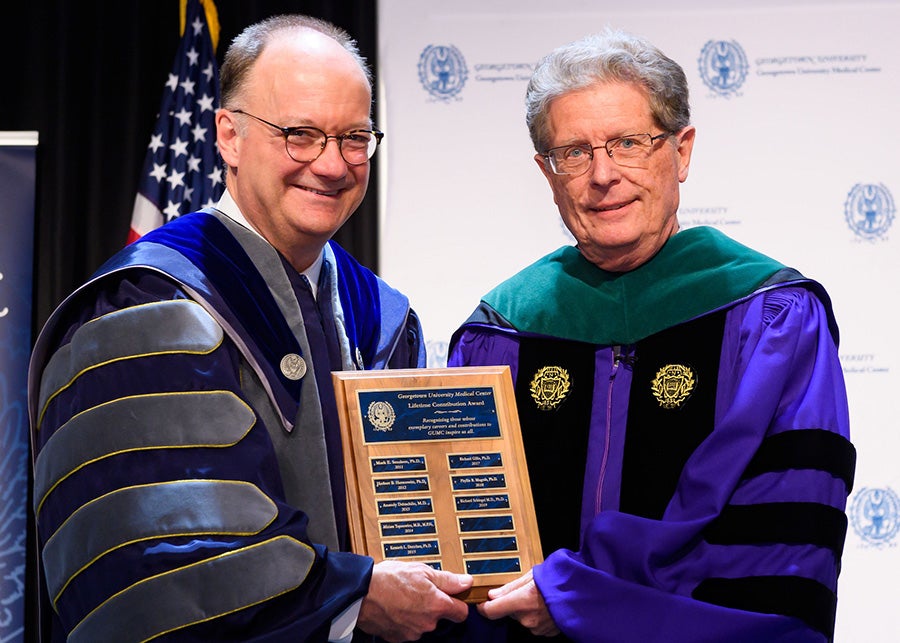
DeGioia presenting Richard Schlegel with the same award in 2019
A Spiral With Children at the Center
A renowned pediatric psychologist, Magrab describes her career as a spiral, with children always at the center and ever-widening rings reaching outward to families, communities and, ultimately, the world. She has earned international recognition, as UNESCO chair and a member of the U.S. Afghan Women’s Council, alongside deep collaborations in the D.C. region.
She arrived at Georgetown in 1967 as a clinical intern, initially reluctant to work in a medical setting. She had imagined herself in a university psychology department or a private practice. But a single interaction with a patient shifted her perspective.
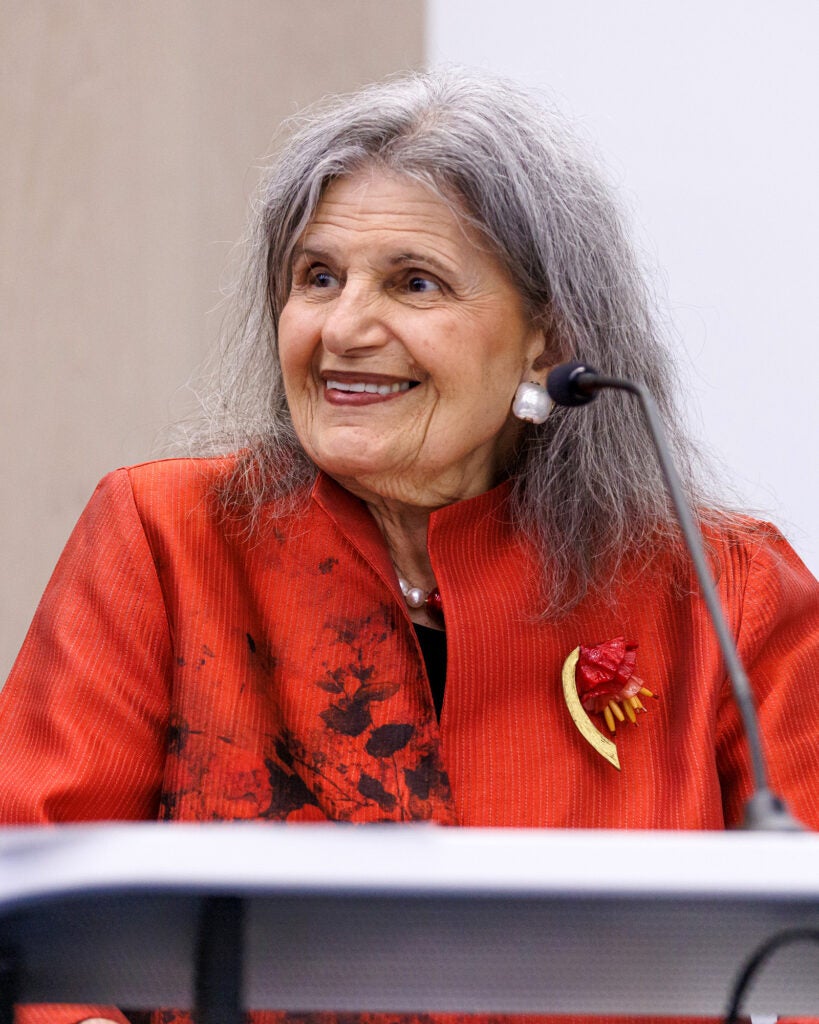
Phyllis R. Magrab, PhD, at a recent Thrive Center event
She was summoned to test a 19-year-old named Calvin, who had hydrocephalus, a buildup of cerebrospinal fluid in the brain. She stood uncertainly at the door, and he called for her to come to his bedside.
“I was so touched when I heard him call out to me, and in that moment I think he gave me my career,” she said.
Magrab went on to become the first woman at Georgetown to earn tenure as a full professor in a clinical department, and eventually served as founding director of what became the Georgetown University Center for Child and Human Development (GUCCHD), which she would lead for more than 50 years.
With a focus on health disparities, special health needs, behavioral challenges in children and youth, and disabilities, GUCCHD garnered international acclaim for its leading role in supporting marginalized groups and working to create a more inclusive society for all children and families. A big point of pride for Magrab is GUCCHD’s pivotal role in the 1991 closure of Forest Haven, D.C. ‘s institution for people with intellectual and developmental disabilities that had long come under fire by advocates and was subject to a class-action lawsuit due to systemic abuse and neglect.
GUCCHD lives on in a new and expanded initiative now known as the Thrive Center for Children, Families, and Communities, which grew out of GUCCHD and MedStar Health’s Division of Child and Adolescent Psychiatry. Magrab worked closely with the Thrive Center’s director, Matthew Biel, MD, MSc, to help ensure the child-focused mission of the GUCCHD would remain a central focus.
Magrab said Georgetown’s Jesuit mission has remained a constant anchor for her work and that of GUCCHD.
“Being in an institution that had values that were so synchronous with mine, the Jesuit underpinnings of social justice and equity really resonated with me from the very start,” she said. “At Georgetown, this commitment is more than just a ‘check mark,’ it’s part of the fabric here.”
That philosophy extended to how she led her center and mentored the people in it. Curiosity was encouraged and “no” was rarely the final answer.
“People were encouraged to explore, to develop ideas that matter to them. My approach was one of, ‘Go for it, try it, see what you can find out, see what you can make happen.’”
Over the decades, that mentorship took many forms and reached many people. Among her students in her early years was Georgetown President Emeritus John J. DeGioia.
Magrab is ready to pass the torch, and is excited for what the Thrive Center will do. She expects it will carry forward with this spirit of inquiry and curiosity, with children and families at the center.
“However the work evolves, my hope is that it will continue to focus on those children and families that are marginalized, excluded and more vulnerable than others,” she said.
That continuity is reflected in the recent installation of Neal Horen, PhD, as holder of the Phyllis R. Magrab Endowed Chair. An associate professor of pediatrics and director of infant, early childhood, and relational health at Thrive, Horen is one of the country’s foremost experts in early childhood mental health systems and a fitting steward of the values Magrab has spent nearly six decades building.
“I started at Georgetown as an intern — I’ve been here almost 30 years and never had a job interview anywhere else, because I really believe this is the place that’s fostering change,” Horen said. “Phyllis’ legacy is a center full of people who feel called to carry this work forward, the same way she felt called when Calvin reached out to her all those years ago. That’s what she built here. That’s what we’re inheriting.”
Magrab plans to remain at Georgetown as professor emerita, continuing work that is important to her and to the university. That work includes chairing the faculty council at the Global Health Institute, participating on the Thrive Center’s AI committee, continuing her work with UNESCO on the ethics of artificial intelligence, and teaching.
She is also writing a formal history of her center, drawing on interviews she conducted with former faculty and staff going back 50 years. While she intends to fit her work around her life, rather than the other way around, she does not plan to disappear.
“I’m definitely not fading into the distance, as long as I can keep doing what I love,” she said.
It Starts and Ends With Cells
For Schlegel, the through line of a career punctuated by discoveries that have saved millions of lives has always been a deep and abiding interest in basic cell biology.
He joined Georgetown in the mid-1980s, coming from the National Institutes of Health to collaborate with the late Alfred Bennet Jenson, MD, on a question of whether a vaccine could be developed against human papillomavirus (HPV), which causes over 90% of cervical cancer worldwide.
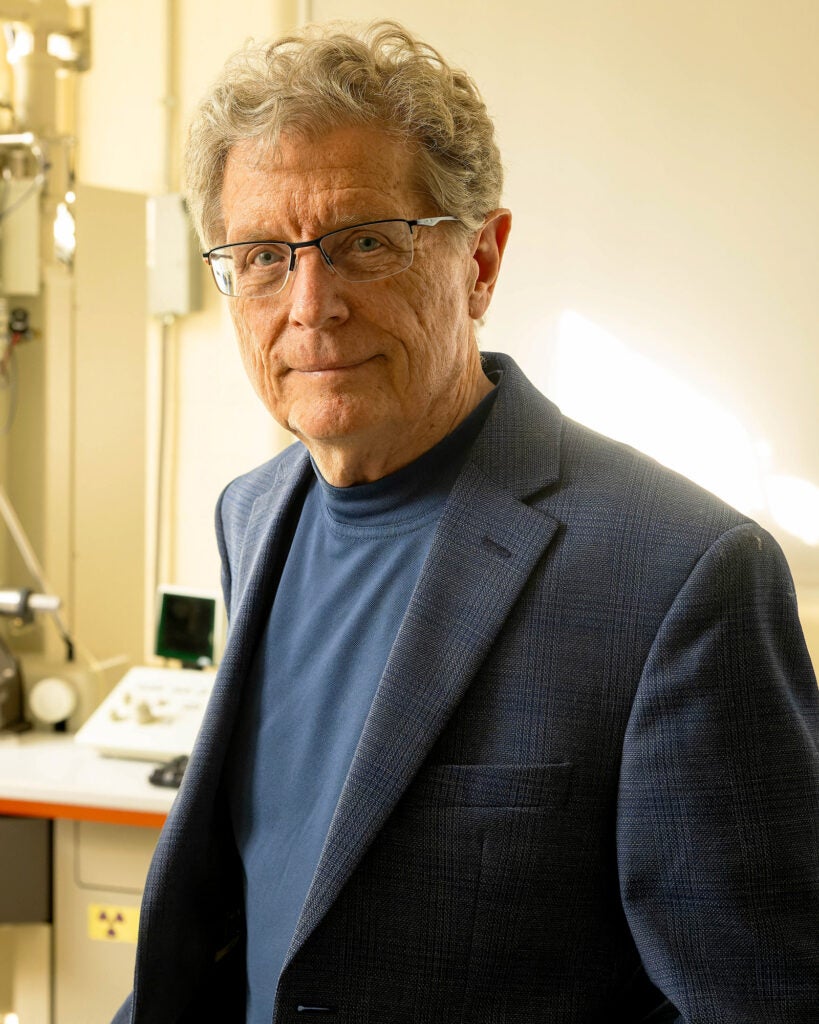
Richard Schlegel, MD, PhD
Work from his lab and this collaboration became foundational to the development of an HPV vaccine now credited with the potential to effectively eliminate cervical cancer — the fourth most common cancer in women worldwide — in countries with strong vaccination programs. Schlegel describes the scale of that impact with disbelief and humility.
“I would have been happy just studying cells and having some basic discoveries. Everything else has been a bonus,” Schlegel said. “That’s why sometimes it doesn’t seem real, because it’s not something I was setting up as a goal.”
He said he has always been fascinated by the processes that take place at the cellular level — understanding the cellular underpinnings of life is what has kept his passion alive over the years.
While pursuing the HPV work, Schlegel’s lab made a second major discovery. A longstanding problem in cancer research is that cell lines used in laboratory studies often diverge so significantly from the original tumor that they no longer accurately represent the cancer’s biology.
Schlegel and his team developed a technique known as conditional reprogramming that allows both tumor and normal cells to be grown indefinitely from a patient’s own tissue, quickly and without that degradation.
Published in a 2012 paper in the New England Journal of Medicine and now known as the Georgetown Method, it has been adopted by the National Cancer Institute and is being used by investigators worldwide. He has also pursued a topical treatment for cervical dysplasia using a derivative of the anti-malarial drug artesunate. This is a potential therapy that could be self-administered without surgery, with particular value for women in low-resource settings.
Schlegel credited Georgetown’s size as an asset in making this breadth of work possible. At a larger institution, researchers can become isolated within their disciplines. At Georgetown, the relationships were more accessible.
“You really get to know people and converse with them in different areas, which I think is really important for collaboration,” he said. “Georgetown is big enough, but not so big that you can’t work with people in different disciplines.”
In mentoring the researchers who came through his lab, Schlegel said his primary goal was to change how trainees thought about their work.
“Before they left my laboratory, I was hoping they would be converted to a phenotype where when they got up in the morning, the first thing they thought about was, ‘That would be a really good experiment to do today, or question to answer.’ I wanted science to become part of their life.”
Ewa Krawczyk, PhD, associate professor of pathology at Georgetown, recalled with fondness how Schlegel’s style of leadership impacted her.
“I came to the U.S. in 2005 to work as a postdoc in Dr. Schlegel’s laboratory. It literally changed my life. Because of him, I learned about science and research, but also about collaboration and what it takes to run a lab,” she said.
Krawczyk, who is also active in science communication and public advocacy for vaccines, found in Schlegel a mentor who showed up beyond the lab. When navigating challenges that can come with speaking publicly about science, she turned to him for guidance. He helped her understand how to hold her ground with confidence, and how to stay grounded in science.
“He was not only a boss, he was a great mentor in research and in life,” she said. “I will always remember and cherish it.”
As he steps back from his full-time role, Schlegel is focused on seeing select projects through to completion, among them the ongoing clinical trials on cervical dysplasia and continued basic science work on telomerase. He plans to remain at Georgetown in an emeritus capacity, lending his expertise as a consultant and collaborator. He also hopes to find time for more leisurely pursuits, such as tennis, sailing and traveling to see his grandchildren.
Schlegel has been nurturing the scientific curiosity of his eight-year-old grandson, bringing him to Georgetown and coaching him on the craft of asking good questions.
“In general, parents don’t love it when their kids start to question everything, but that’s exactly what I was going for,” he said.