Evans Encourages Collaboration in Research and Teaching

Rebekah Evans, PhD
(February 17, 2026) — During her undergraduate studies at St. John’s College, which is known for its curriculum focused on reading and analyzing classic books, Rebekah Evans, PhD, developed an interest in neuroscience.
“In all of the philosophy discussions we were having, I started to think, we’re asking how do we know things, what is thinking,” she said. “I thought, maybe we could do some actual experiments in the brain and answer some of these questions.”
That interest prompted Evans to earn a PhD in neuroscience at George Mason University and do a postdoctoral fellowship at the NIH’s National Institute of Neurological Disorders and Stroke before joining the neuroscience faculty at Georgetown as an assistant professor in 2021.
“I really liked the collaborative atmosphere when I came for my interview,” Evans said. “A lot of places, when you go interview, will say they’re collaborative. But I could see that that was the case here.”
Through her teaching, research and mentoring, Evans works with undergraduate, graduate and postdoctoral students, promoting the collaborative environment that drew her to Georgetown.
“I’m just constantly surprised by the students’ support of each other,” she said. “I know I’m supposed to support them and take obstacles out of their way, but it just warms my heart when I can see them helping each other.”
Understanding the Early Stages of Parkinson’s Disease
Evans studies the neural circuitry involved in the development of Parkinson’s disease to learn about how the disease develops from its earliest stages. “One of the most important things with understanding the first steps of Parkinson’s is, that’s when you can do intervention,” she said. “Knowing what’s happening earlier can help us figure out ways to prevent it from developing or stop it before it gets symptomatic.”
To measure neural activity in mice with a very mild version of Parkinson’s disease, Evans uses fiber photometry, implanting a glass fiber optic into their brains, which provides real-time information about what cells are being activated in response to a stimulus. “It’s a well-established neuroscience technique,” she said.
“We’re turning lights on and off and seeing how neurons respond,” Evans added. “We do a lot of really interesting sensory motor experiments.”
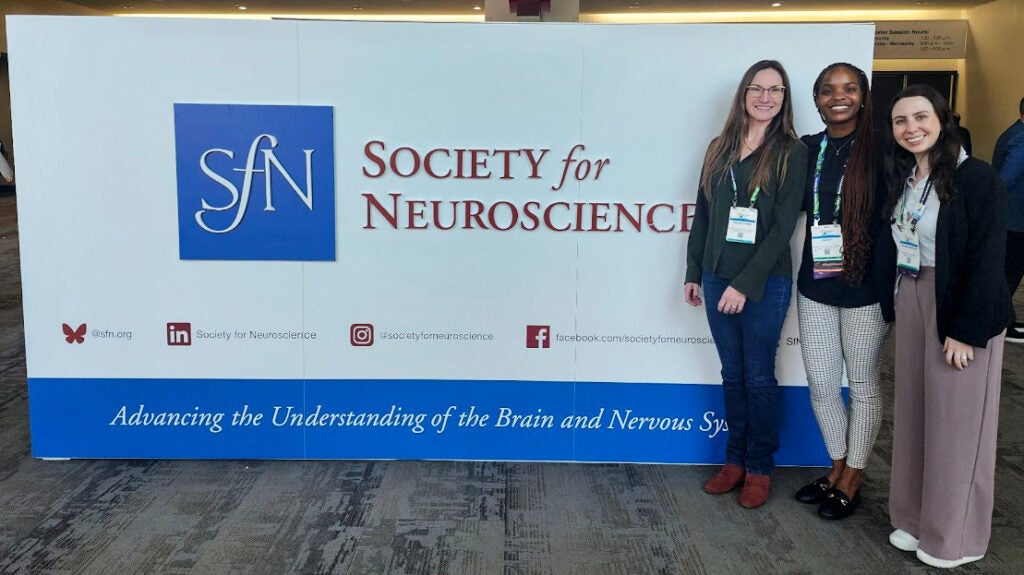
(From l) Evans with PhD students Lindsey Russ and Briana Bernstein at the 2025 Society for Neuroscience Conference, where both students presented their research. In her lab, Evans works with undergraduate, graduate and postdoctoral students, promoting the collaborative environment that drew her to Georgetown.
Researching Exercise and the Brain
In addition to learning more about how Parkinson’s disease develops, Evans is looking at how exercise changes the brain. “Throughout my whole career, I’ve been interested in motor circuitry that underlies not just your ability to move but the way you learn to do really high level, high skill movements,” she said.
While Parkinson’s disease is attributed to a decrease in dopamine-producing neurons in the brain, Evans’ research shows that dopamine neurons are easier to activate after exercise, suggesting that exercise may be linked to reduced risk.
“One of our manipulations is to give the mice exercise,” she said. “They run on a running wheel in their cage, and it’s been shown to be protective.”
“The dopamine neurons are really well known for helping boost your mood, so them being easier to activate during exercise might be one of the ways that exercise can help,” Evans added.
Merging Research Interests
Since coming to Georgetown, Evans has received research funding through a K99/R00 career development grant from the NIH Brain Initiative, the Michael J. Fox Foundation, the Brain Research Foundation Seed Grant, the Persimmon Foundation, American Parkinson’s Disease Foundation and Georgetown’s Partners in Research.
“One particular award that I’m fond of is the Stanley Fahn Junior Faculty Award from the Parkinson’s Foundation,” she said. “I was really, really proud to get that. It came with funding for a project, but it’s also an award for early stage faculty who are just starting their labs.”
Looking ahead, Evans hopes to make more connections between her research on Parkinson’s disease and the impact of exercise on the brain. “We’ve started with these different projects with the Parkinson’s disease mouse and the exercise mouse, and now we want to merge them together,” she said.
Educating Students in the Lab and Lecture Hall
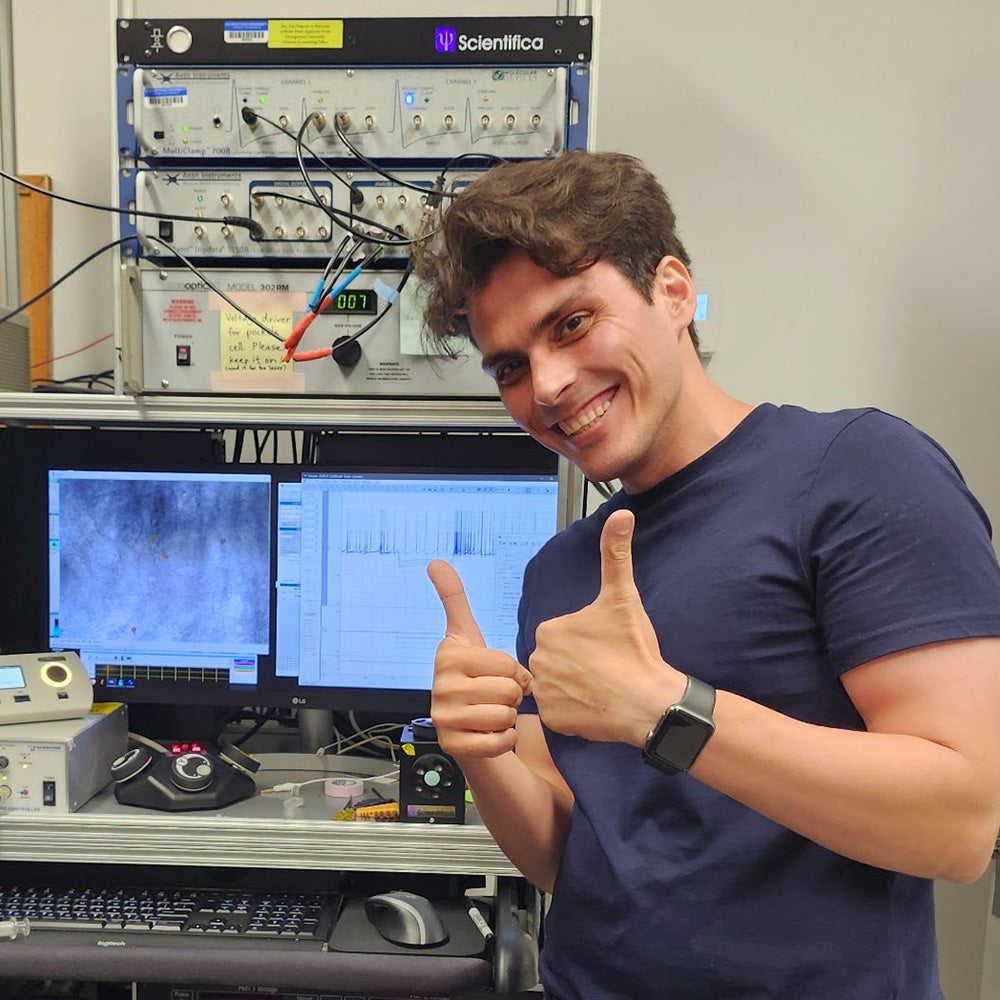
Hassan Hosseini, a first-year student in the IPN, celebrating success in the Evans Lab. “I think it can be really, really fun when you can see a student learn something, like when the light bulb goes off,” Evans said.
In her lab, Evans brings together undergraduate students in biology, graduate students from the Interdisciplinary Program in Neuroscience (IPN), doctoral students in pharmacology, and postdoctoral fellows. They have published research in Frontiers in Neural Circuits, Neurobiology of Disease, the European Journal of Neuroscience, eLife, the Journal of Neuroscience and Nature Communications.
The thrill of making scientific discoveries with her students is a fulfilling experience for Evans. “I think I’ll never get over the feeling of how exciting it is to feel like the first people who know something,” she said. “I feel so, so grateful that the people who decided to join my lab built a strong community to push forward all of the scientific projects.”
Evans also teaches medical students, IPN students and students in the MS in neuroscience program. In recognition of her “sincere interest and meaningful engagement in student growth, through both formal and informal support,” Evans received the IPN Faculty Magis Award in 2025.
“I like teaching a lot actually,” she said. “I think it can be really, really fun when you can see a student learn something, like when the light bulb goes off. That’s a really amazing experience to see in someone else.”
Working closely with medical students is especially enjoyable for Evans. “I like to teach the medical students in the neuroanatomy labs because we’re right there with them in the lab,” she said. “It’s not like a gigantic auditorium. It’s really an interaction, and I love that because they can ask a question and you can get a sense of where they’re at, so you can build on that.
“I love seeing students get excited about a topic,” Evans added. “The students this year have been asking a ton of questions, and it’s been really fun.”
Kat Zambon
GUMC Communications